
Ontario’s 2026 Budget arrives with a familiar promise of protection, but for whom?
The province faces compounding pressures, including a deficit that has nearly doubled to $13.8 billion, ongoing U.S. tariff threats, and the ripple effects of global instability that are already filtering into the cost of living for Ontarians. These are real and serious headwinds, and they demand real and serious responses.
The government has responded to these pressures with an HST rebate for new homebuyers and a small business tax cut. These measures are not nothing, but they’re aimed at a very specific crowd. For nearly one million Ontarians who rely on social assistance, among the most exposed to every economic shock, this budget does not offer protection.
It offers surveillance, underfunding, and a continuation of the quiet, year-over-year erosion of supports that were already inadequate before inflation compounded the gap.
Systemic Undercounting of Social Assistance Demand
This budget shows that the government has been forced to acknowledge that its earlier projections underestimated the growing demand for social assistance. Projected spending for the Ministry of Children, Community and Social Services has been revised upward from the Fall Economic Statement figure of $20.4 billion to $21.5 billion, driven by what the budget itself acknowledges is growing “demand for social assistance programs.” That is a significant revision within a short window, and it is an implicit admission that the need is larger than what the government projected, and that its own forecasts have consistently underestimated this growing need.
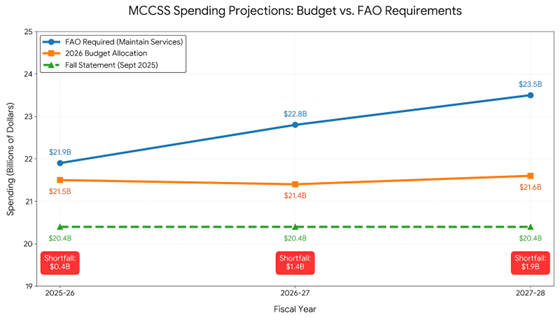
Even the revised $21.5 billion allocation falls well short of what is actually needed. The Financial Accountability Office projects a funding shortfall of $1.4 billion this year alone, growing to almost $ 1.9 billion by 2027-28, simply to maintain current service levels.
There is little reason to believe this trajectory will change on its own, given the lack of a comprehensive approach for low income job-seekers, next to no increased support for people who are unable to work, and no meaningful action on price-gauging. The only significant new investment in social services is the $186 million for the Ontario Autism Program, building on last year’s $60 million increase to improve services for children and youth. This is positive movement, but with more than 67,500 children still on the waitlist and past funding increases failing to make a dent, such announcements risk repeating a pattern of symbolic action without real progress.
OW Rates Continue Their Decline
At the heart of this budget’s failure on poverty reduction is the government’s continued refusal to raise Ontario Works (OW) rates, despite how clearly inadequate they have become.
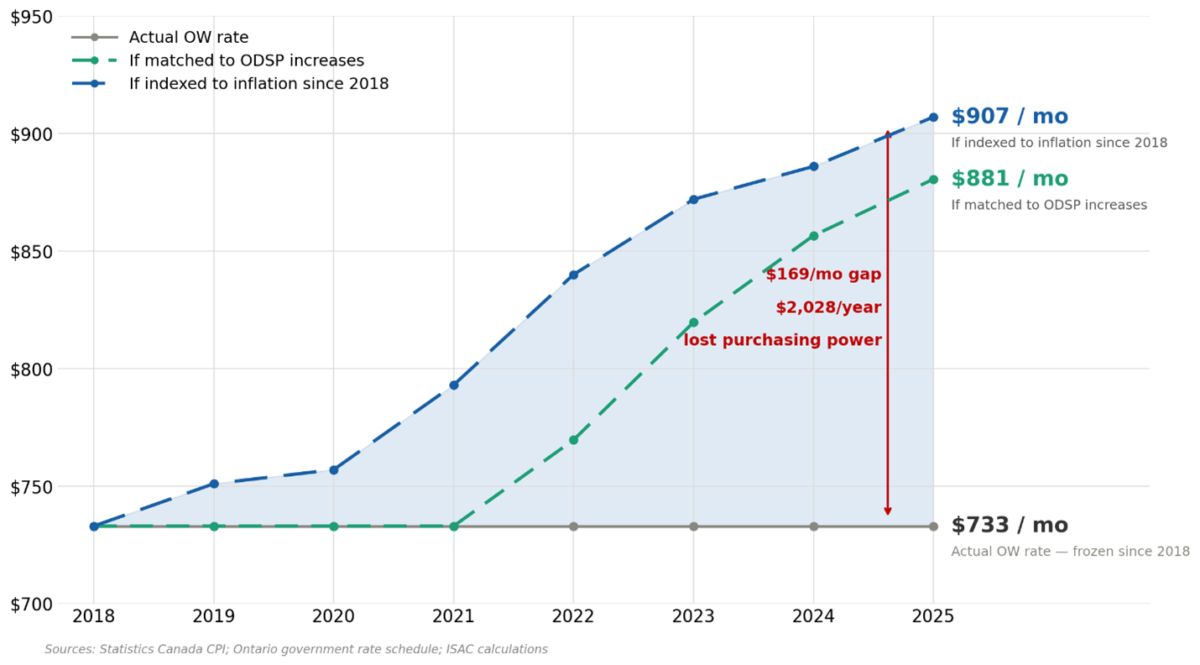
OW rates have remained frozen at $733/month for a single Ontarian since 2018. This has real impact as 82% of OW recipients report significant erosion in purchasing power due to inflation. In real terms, OW recipients have far less purchasing power today than they did years ago, even before the inflationary pressures of the past several years compounded that gap. While inflation impacts us all, it does not impact everyone equally. The disproportionate inflationary impact on the cost of groceries hits low income earners much harder than middle or high income earners.
If OW rates had been indexed to inflation starting in 2018, a single OW recipient would be receiving $907 per month today – a 23.6% inflation-related increase to the current monthly rate of $733. That inflation-related income gap of $174 per month adds up to an income gap of over $2,000 a year, and represents purchasing power quietly eroded through years of inaction.
Even if OW rates had been indexed to inflation starting in 2023 at the same time that Ontario Disability Support Program (ODSP) rates were indexed to inflation, that would not have been enough to close the inflation-related OW income gap. OW recipients would still face an inflation-related income gap of $148 per month, or $1,776 per year, in lost purchasing power. The 2026 Budget does nothing to close this gap, and it is unfortunately likely to continue widening without concerted intervention.
The budget has accounted for indexing ODSP to inflation, which is the very least the government could do for ODSP recipients. Unfortunately, they point to these very low inflationary increases when deflecting criticism of inaction on OW rates. While inflationary increases to ODSP are necessary, costs continue to outpace inflation-related increases. Two-thirds of ODSP recipients report no real change in their purchasing power due to this annual inflation-related adjustment. Simply indexing rates is not enough to keep up with the affordability crisis while the rates remain so low, and it does even less for those left behind on OW, regardless of whether or not OW is intended to be a temporary program of last resort.
Cracking Down Instead of Building Up
The decision to focus this budget’s social assistance efforts on program “integrity” measures deserves scrutiny. Integrity measures, in the social assistance context, typically mean enhanced monitoring of recipients, stricter verification requirements, and increased investigations into earnings and gifts, often resulting in accounts being put on hold, or high overpayment amounts. These measures impose significant administrative burdens and psychological stress, create barriers that push eligible people off of social assistance programs, and in the end, result in the recovery of relatively modest sums compared to the costs associated with the related administrative work.
Meanwhile, the actual rates that determine whether someone can afford to eat or keep their lights on go unaddressed. The government is spending political and administrative capital making it harder to access a benefit that is already inadequate, rather than making that benefit adequate.
This choice reflects a set of priorities, specifically a view of social assistance recipients as a problem to be managed rather than people to be supported through difficult circumstances.
Postsecondary Investment Undercut by Increased Reliance on Student Debt
The Budget frames its $6.4 billion investment in postsecondary education as transformative, but it arrives alongside an Ontario Student Assistance Program (OSAP) restructuring that shifts the cost of that stability onto the students least able to bear it. Beginning in Fall 2026, non-repayable grants will be capped at 25% of aid, down from as much as 85%, with the majority delivered as loans. For low-income students, this represents a dramatic increase in debt for the same level of support, compounded by the end of the tuition freeze. For students with disabilities, this amounts to an unsurmountable barrier.
The budget describes it as “strengthening the long-term sustainability” of the program by “bringing eligibility for grants and loans in line with that of other provinces” yet overlooks its disproportionate impact. It effectively transfers the cost of system stability onto those least able to afford it, including people with disabilities, and risks deeper financial barriers to education. Making the path to higher education inaccessible to people with disabilities will result in deeper, long-term disability poverty, particularly since people with disabilities experience higher costs of living in general, as well as lower incomes compared to their non-disabled peers who obtain the same level of higher education.
Privatization Leaves Low-Income Workers More Exposed
The budget offers little for low-income Ontario workers who need reliable protection to secure employment and build long-term resilience, as highlighted in our budget submission. Instead, there is an increasingly disconcerting drift toward privatized service delivery across health care, employment services, and economic policy.
The budget’s Protect Ontario Account Investment Fund, introduced as a $4-billion vehicle to “identify and execute on a pipeline of new economy-enabling investment opportunities,” outsources key economic decision-making to a private investment manager acting as General Partner. This approach directs public funds toward profit-driven actors with limited transparency, increasing the risk of mission drift toward commercially attractive investments rather than broader public benefit.
The privatization of employment services for social assistance recipients has already yielded troubling results. The province has increasingly handed employment services to private Service System Managers via a performance-based model that incentivizes placements and retention over actual stability for clients. This new system is failing to meet the needs of many Ontario Works recipients and often creates new barriers to stable employment. Since 2019, the share of OW recipients earning employment income has dropped 43.9%.
Unlike last year’s $50 million investment in Better Jobs Ontario, one of the province’s main re-skilling programs available to people on social assistance, this year’s budget includes no new funding to support vocational and skills training or respond to labour market needs. Instead, the government’s continued push to privatize their public economic strategy, without adequate guardrails, leaves low-income workers more exposed to the economic shocks ahead.
Overall, the budget makes it clear that the government’s protection extends to those whose economic contributions are most visible, measurable, and politically expedient, while leaving the most vulnerable to navigate deepening hardship. It does not extend to those whose poverty is treated, year after year, as a personal failure to be shamed rather than a societal failure worth remedying through societal solutions.
Poverty is a policy choice. And the budget has chosen to widen the gaps, instead of reversing them.