
Nearly one million Ontarians rely on social assistance programs like Ontario Works (OW) and the Ontario Disability Support Program (ODSP) for survival. These are programs of last resort, a lifeline for those with nowhere else to turn.
So how well are they actually working?
According to ISAC’s new report In Their Own Words: A Recipient-Informed Case for Fixing Ontario’s Social Assistance System released today, not nearly well enough.
The report draws on anonymous responses from focus group participants and 200 OW and ODSP recipients surveyed from across the province in Fall 2024. The report includes original data analysis on the impact of inflationary increases to social assistance, access to services and employment opportunities, and the intersection of disability and employment, along with first-hand accounts of what it’s like to try to live on social assistance in Ontario.
It is, above all, a document built on the lived experience of people navigating a system that was meant to catch them, but which has let them down again and again.
The numbers tell a bleak story: Income support is too low, and dropping further due to inflation
At the heart of the report is the glaring inadequacy of current benefits. Nearly 83% of all survey respondents live in households earning under $30,000 per year.
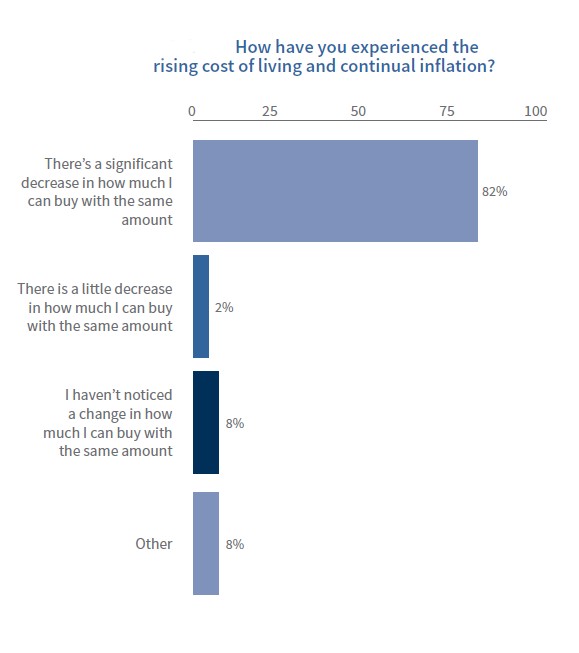
OW rates have been frozen since 2018, meaning their real value continues to erode with every year of inflation. More than four in five OW recipients (82%) report a meaningful loss in purchasing power as a result.
While ODSP is indexed to inflation, two out of three ODSP recipients reported no meaningful change in purchasing power. Rent increases, food inflation, and rising utility costs consumed any gains before recipients could benefit from them.
When asked what they would do with additional funds, respondents made it clear that their priorities are survival – basics like food and rent, not extravagant items. This counters the idea of benefit misuse. Over half of ODSP recipients (52%) said they would prioritize spending it on food and groceries; nearly half of OW recipients (47%) said they would put it primarily toward rent.
Recipients suggested median increases of $800 for OW and $1,500 for ODSP just to cover essentials.
“Nobody wants to be on assistance”: Structural barriers keep people on assistance and in poverty
One of the most powerful and consistent themes across both the survey and focus groups was the deep desire among recipients to work, contribute, and achieve independence. Participants repeatedly said that “nobody wants to be on assistance”, that relying on OW or ODSP felt humiliating and demoralizing.
The barriers described by survey respondents in the report are real and structural, such as unaffordable childcare, language barriers, non-recognition of foreign credentials, no upfront funding for job training, and workplaces that do not accommodate disabilities.
For many, finding work doesn’t solve the problem. OW recipients lose 50 cents of benefits for every dollar earned over $200 a month, sometimes leaving them worse off than staying on assistance.
One respondent put it plainly:
“First and foremost, remove clawbacks of all kinds. They are the most detrimental to how the system functions. If I had the choice between doubling the income or clawback removals I would pick clawback removals.”
A quarter of all respondents called on the government to eliminate clawbacks entirely.
Disability does not fit neatly into bureaucratic categories
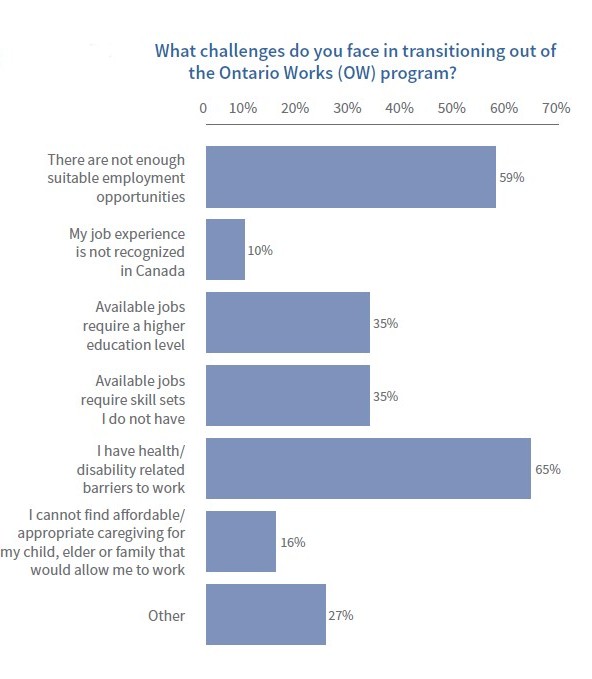
A key finding of the report is how poorly the current system reflects the lived realities of disability. 65% of the respondents on OW reported health or disability related barriers to work. Yet they are stuck on OW because their ODSP application was denied, delayed, or fell into a bureaucratic grey zone, receiving less support while their health deteriorates.
As one respondent put it:
“So many genuinely disabled people are dying and having their disabilities worsen on OW when getting them onto ODSP would help provide some resources and access that could help us heal and get back to work instead of leaving us worsened, so we are stuck in the welfare system forever.”
43% of all respondents reported being unable to work at all due to disability. Among the lowest-income ODSP recipients, that number climbs to over 60%.
Respondents described paying out of pocket for medications, dental care, mobility aids, and medically necessary diets – expenses that either require exhausting documentation to access or aren’t covered by ODSP at all. The process of obtaining adequate medical documentation to prove eligibility is itself costly, time-consuming, and deeply stressful for people who are already unwell.
Caseworker and Administrative Failures
Beyond inadequate benefit levels, respondents reported widespread problems with how social assistance is administered. Service ratings across measures averaged 3.25 – 3.75 out of 5 across measures, with ODSP recipients consistently reporting worse experiences than OW recipients.
More than half of all respondents provided written feedback about their service experiences. The most common complaint, raised by nearly 4 in 10 respondents, was caseworker inaccessibility and poor communication: unreachable workers, frequent staff changes, and information that seemed incorrect or inconsistent. Close to 3 in 10 reported being treated rudely or in a dehumanizing way.
Indigenous recipients reported particularly severe disparities. They reported problems accessing information at more than twice the rate of non-Indigenous respondents, and experienced discrimination at more than three times the rate.
Overall, administrative errors and delays compounded recipients’ distress, with files suspended without warning, overpayments issued in error and difficult to dispute, and approvals taking years. One ODSP applicant reported waiting four years just for approval.
One respondent wrote:
“ODSP Caseworkers should be aware of their clients’ disabilities. If they did, they would be able to communicate much better with their clients — and wouldn’t be so quick at cutting off benefits and making stupid decisions because of ‘assumptions’ that their clients are ignoring them.”
Employment Barriers: From Gig Work to Health Risks
For recipients who are employed, working conditions often deepen their vulnerability. Nearly 1 in 5 reported working low-wage gig jobs without benefits, and 56% had no access to paid sick leave.
As a result, 53% said they worked while sick because they could not afford to miss a shift, sometimes in unsafe conditions. This reflects a labour market that fails to protect vulnerable workers, combined with benefit rates and minimum wage too low to allow even a single missed day of work.
Fixing Ontario’s ODSP and OW Programs
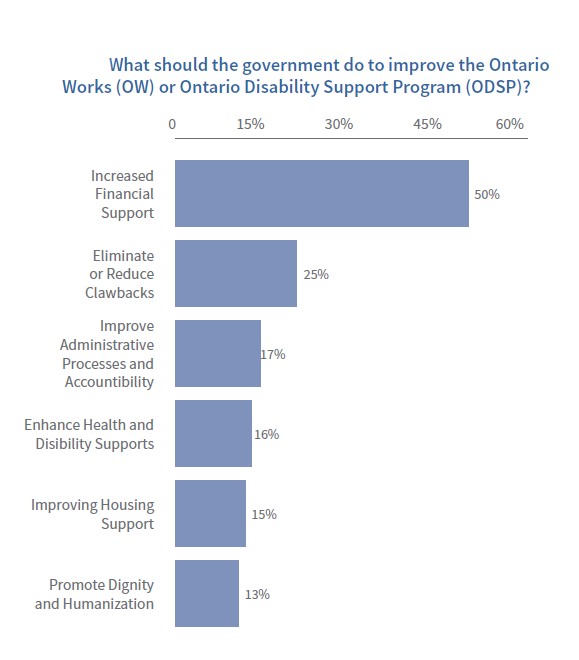
Open-ended survey responses highlighted these key recommendations:
- Increase Financial Support: Half of respondents called for significantly higher income support rates, benchmarked to Ontario’s official poverty line.
- End Clawbacks: Remove or delay clawbacks on earnings, federal benefits, and spousal income until income exceeds the poverty line, so work is not financially penalized.
- A System That Works: Recipients want caseworkers who are reachable, consistent, and communicative, and effective ways to address problems when they arise.
- Health and Disability Supports: Expand coverage for mental health, medications, assistive devices, and therapy, while easing ODSP access for people with disabilities.
In their Own Words in Today’s Political Context
The voices of 200 Ontarians on social assistance in the report go beyond critique and offer a clear, recipient-informed roadmap on how to fix a broken public system intended to support the most vulnerable.
But acting on that roadmap will require the government to drastically change course. The Ministry of Children, Community, and Social Services is projected to spend billions less than required to maintain even current service levels in the coming years, while ignoring likely caseload increases from population growth, aging, unemployment, and inflation. OW is likely to bear the brunt of this gap, as rates remain frozen and their real value continues to erode.
Finance Minister Peter Bethlenfalvy’s recent warning that the province must “brace for tougher times” amid economic uncertainty offers little reassurance to the roughly 1 in 15 Ontarians who currently rely on these supports, particularly as caseloads are projected to grow.
The programs’ structural design is increasingly misaligned with reality. They operate on a binary assumption that a person either can work fully or cannot work at all, offering no meaningful middle ground for partial or episodic ability to work. This oversight is becoming increasingly consequential as disability rates in Canada continue to rise, due to factors such as an aging population, increasing mental health challenges, and the long-term effects of COVID-19. A framework that ties survival strictly to a rigid definition of “ability to work” is a framework that is structurally incapable of responding to the lived realities of disability.
The case for immediate systemic change is both moral and fiscal. Inadequate social assistance drives up emergency healthcare, shelter, and food bank costs, costing the provincial economy tens of billions of dollars every year. Every dollar invested in adequate income support prevents multiples of that in downstream spending and fosters healthier, more stable communities.
Ontario has both the resources and the knowledge to act. What remains is political will.
“Don’t forget we are also human and not magicians trying to live off as little as we can while prices are rising.”
Ce rapport est également disponible en français. Voir ci-dessous.